
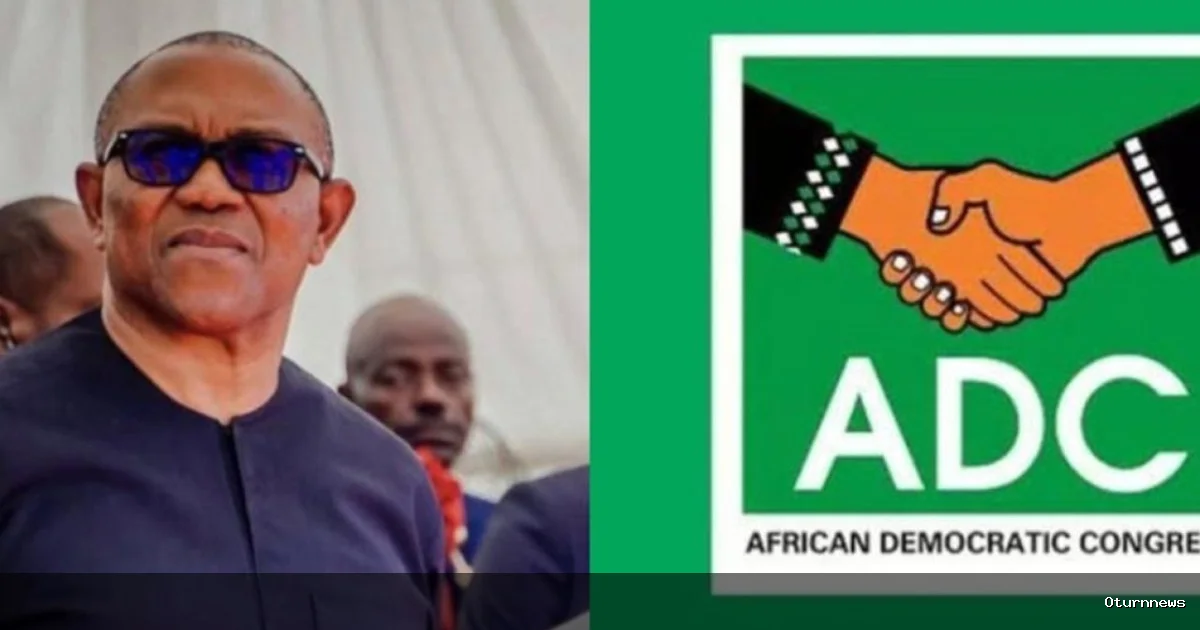
A significant new development in Nigeria's evolving 2027 opposition landscape has emerged following reports that Labour Party's 2023 presidential candidate Peter Obi and key figures within the African Democratic Congress are considering a political realignment that would move them away from the current alliance structure involving former Vice President Atiku Abubakar and former Kaduna State Governor Nasir el-Rufai toward a different party arrangement ahead of the 2027 general elections.
The reports, which were circulating among political analysts and journalists on Friday, add another layer of complexity to opposition coalition building that has been one of the defining political stories of 2026. The Ibadan summit of opposition leaders just days ago produced a declaration of unity, but the details of how that unity would be structured, who would lead it, and on which party platform it would be expressed were deliberately left unresolved. The ADC movement reports suggest that those unresolved questions are already generating significant behind-the-scenes activity.
More in Politics
- Peter Obi or Atiku: Primate Ayodele Reveals Who Would Win the ADC Presidential Ticket for 2027
- INEC Takes Fresh Action on ADC After Supreme Court Ruling on Party Convention
- Osifo Stanley Defies Tinubu Consensus to Declare APC Presidential Bid for 2027
- Peter Obi Describes Nigeria as Disgraced Under Tinubu as Opposition Summit Puts 2027 on Notice
- David Mark: Nigerians Have Lost Confidence in INEC and the 2027 Elections Are at Risk
JJ Omojuwa's Claim
Digital strategist and public commentator JJ Omojuwa made the claim on Friday May 1 that Rabiu Musa Kwankwaso may align with Peter Obi and move to another party ahead of the 2027 elections. Omojuwa's commentary is frequently based on sources within political circles and his observations on Nigerian politics are taken seriously by observers who track the rapidly shifting alignments of the pre-election period.
If the reports are accurate, they suggest that the current grouping of Atiku, El-Rufai, and the broader PDP-adjacent opposition faction may not be the formation through which Peter Obi ultimately contests 2027. A realignment that brings Obi and Kwankwaso together on a different platform would create a new political combination whose potential electoral strength would be calculated differently from the current coalition's composition.
Why This Matters for 2027
The composition of the opposition coalition and the party platform it uses to contest the 2027 election are not merely structural details. They determine the electoral arithmetic of the contest, the geographic and demographic reach of the opposition's voter mobilisation, the financial resources available to the campaign, and the credibility of the alternative being offered to Nigerian voters who are dissatisfied with the Tinubu administration but want to vote for something coherent rather than simply against the status quo.
Every shift in the opposition's internal arrangements affects those calculations. The next several weeks will be critical in determining whether the unity declared at Ibadan translates into an actual unified structure or whether competing ambitions and strategic calculations produce yet another fragmented opposition field that, as in 2023, delivers victory to the incumbent through the mathematics of vote splitting rather than genuine popular preference.
Comments
Leave a Comment
All comments are reviewed before publishing.